The Artemis II mission launched on April 1st, marking the first crewed mission to the moon since 1972. This project has been heavily publicized for several reasons, including the fact that the crew has set a new record for the furthest humans have ever traveled from Earth, moving 252,756 miles away from our planet. The previous record was set by Apollo 13 in 1970 with a distance of 248,655 miles from Earth. The astronauts traveled in a loop around the far side of the moon before returning home.
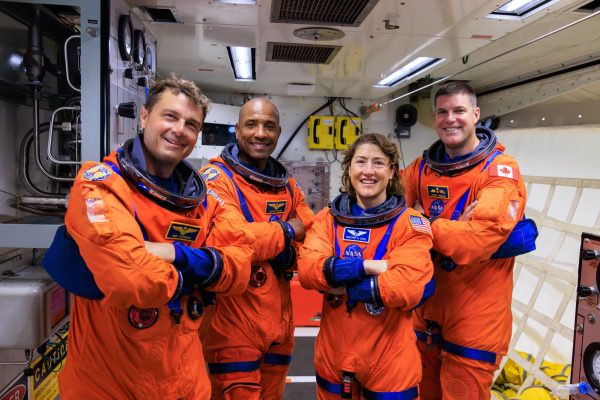
Another reason this mission has gained so much attention is the members of its 4 person crew. Victor Glover, Christina Koch, Jeremy Hansen, and Reid Wiseman have all set their own records, becoming the first person of color, woman, non US citizen, and oldest person, respectively, to travel beyond low earth orbit. In addition to proving themselves as inspirations for these reasons, these astronauts have also brought joy to the American public by making the success of their mission into a piece of national good news. People have come together across typical divides to celebrate this NASA mission as a national success.
Even the astronauts themselves have preached this message of unity. In a standout moment, Christina Koch spoke about one of the greatest lessons she learned while visiting the moon: “A crew is a a group that is in it all the time, no matter what, that is stroking together every minute with the same purpose, that is willing to sacrifice silently for each other, that gives grace, that holds accountable. A crew has the same cares and the same needs, and a crew is inescapably, beautifully, dutifully linked. I know I haven’t learned everything that this journey has yet to teach me, but there’s one thing I know. And that is, planet Earth, you are a crew.”

But the key concept the Artemis II has become famous for is its purpose. As a part of the Artemis Project, this lunar flyby is testing new technology and design for future moon missions. NASA’s program formally aims to land humans on the moon again by 2028, and to eventually develop a permanent moon base in the 2030s, which could open doors to deeper space travel. Although there are many things to consider when it comes to human expansion in space, most people seem to be very excited about it. “I’m all for it, especially as a launching point for future missions. I hope I live to see the day that human boots are on Mars!” said LHS physics teacher Mr. Smith.
Overall, this mission drummed up a lot of excitement in America, online, and at LHS for space travel. Many students were excited to see such a significant space project happen in real time. “I just love the fact that students are talking about it and curious about it,” said Smith. “It has led to a lot of great conversations both in the classroom and in our teaching offices, as well as with my own kids.”
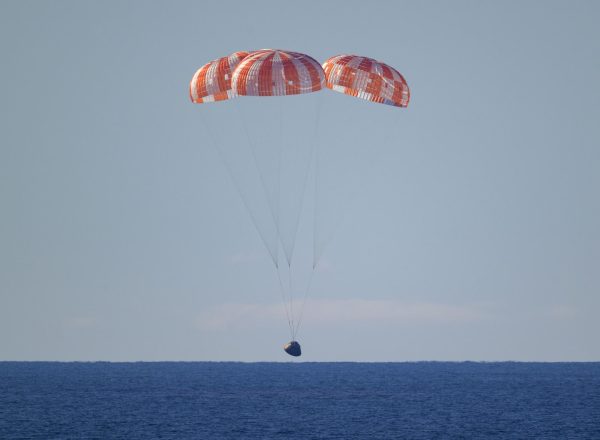
The Artemis II returned to Earth at 7:07 PM on Friday, April 10, splashing down in the ocean near San Diego. All four astronauts are confirmed to be healthy and uninjured, and have been reunited with their families, closing the book on this chapter of space exploration.